
Lady of Heliké
Awarded by The Royal Society of Miniature Painters, with "The Mundy Sovereign Portrait Award" and "Award for First Time Exhibitor"
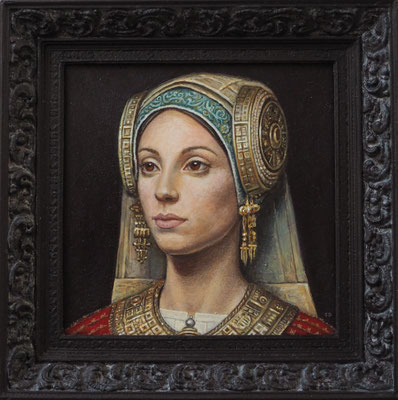
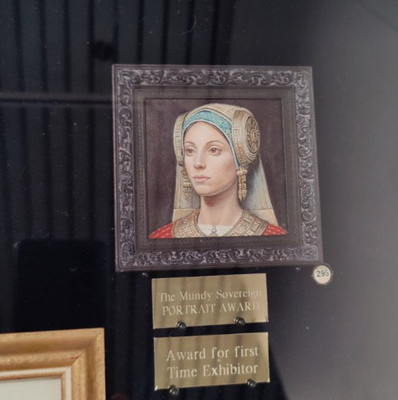

Lady of Heliké © 2025 by Fátima Doña Molinero is licensed under CC BY-NC-ND 4.0. To view a copy of this license, visit https://creativecommons.org/licenses/by-nc-nd/4.0/
The Lady of Heliké
Size: 7,5 x 7,5 cm (painting) / 10,5 x 10,5 cm (size with frame)
Technique: Acrylic and pure pigments (for the background and the
dress). Painted on synthetic ivory (Ivorine), this piece has gold leaf on the back (the support is a little translucent and this ancient technique was used to give
luminosity to the face, it is an old “backlighting system”)
On the theme of this painting:
This painting is inspired by the 5th–4th century BCE sculpture known as the Lady of Elche. The original is carved in limestone and is regarded as a masterpiece of Iberian art. Several sculptures of this typology have survived, sharing common features such as large necklaces, earrings, and a headdress with a mantle. According to some theories, these figures may have represented deities, or alternatively aristocratic women, priestesses, or members of high social standing. Each “Lady” tends to display distinctive local attributes—for example, the Lady of Baza holds a bird in her hand, while the Lady of Elche is characterized by the large wheel-like coils flanking her head. It is also known that these sculptures were originally polychromed with a rich palette of colors, including gold, blue, and red.
In my painting, I wished to represent the Lady of Elche as if she were a living person of flesh and blood. It is therefore an evocative and personal artistic interpretation rather than a historically faithful portrait—something freer and more poetic. I have always been fascinated by the mystery of these images, which echo aspects of Classical Greece, yet also reveal subtle Eastern influences and, above all, highly distinctive elements of the local culture that flourished in the region. In the 5th century BCE, the city was known as Heliké—It is the Greek name that was given to the city at its origin. Later, under Roman rule, the city was called Ilici. At some point in the history of this and many other settlements, these figures were deliberately damaged—decapitated, broken into fragments, or reused as building material—perhaps as a way to erase the power and culture of earlier inhabitants.
The theme of the exhibition, “The Changing Face”, inspired me to create a work that would reflect the aesthetic of this remote and enigmatic culture, where the ornaments of the head were as important as the face itself. These adornments served as family symbols (or trascendent symbols), and some scholars suggest that such jewelry may have been passed down from generation to generation, carrying within them the story of familial legacy. My intention was to depict an image of a serene woman, painted with a subtle color palette. It is a face that might belong either to a woman of antiquity or to one of today—the difference lies only in the cultural context.
It is also known that such sculptures were placed in necropolises, often with a cavity at the back or side to contain the ashes of the deceased. The figure is thus presented in her finest attire, perhaps prepared for the most significant journey of all—into the afterlife. I found it compelling to reflect on the dialogue between ancient faces, ritual practices, and the passage of time: how, in looking back and attempting to reconstruct or understand the lives and cultures of past civilizations, we are simultaneously confronted with wonder and self-discovery. We realize that there are shared human concerns—mysteries of life and death, the care and devotion we show to loved ones even after their passing. We strive to preserve their memory with an enduring affection that survives across the centuries, as if in a time capsule. Thus reemerges the Lady of Heliké, gazing with serenity, as though wishing to tell her story.